




- Military
- History
- International Affairs
- US Foreign Policy
- Russia
- Science & Technology
- Reforming Education
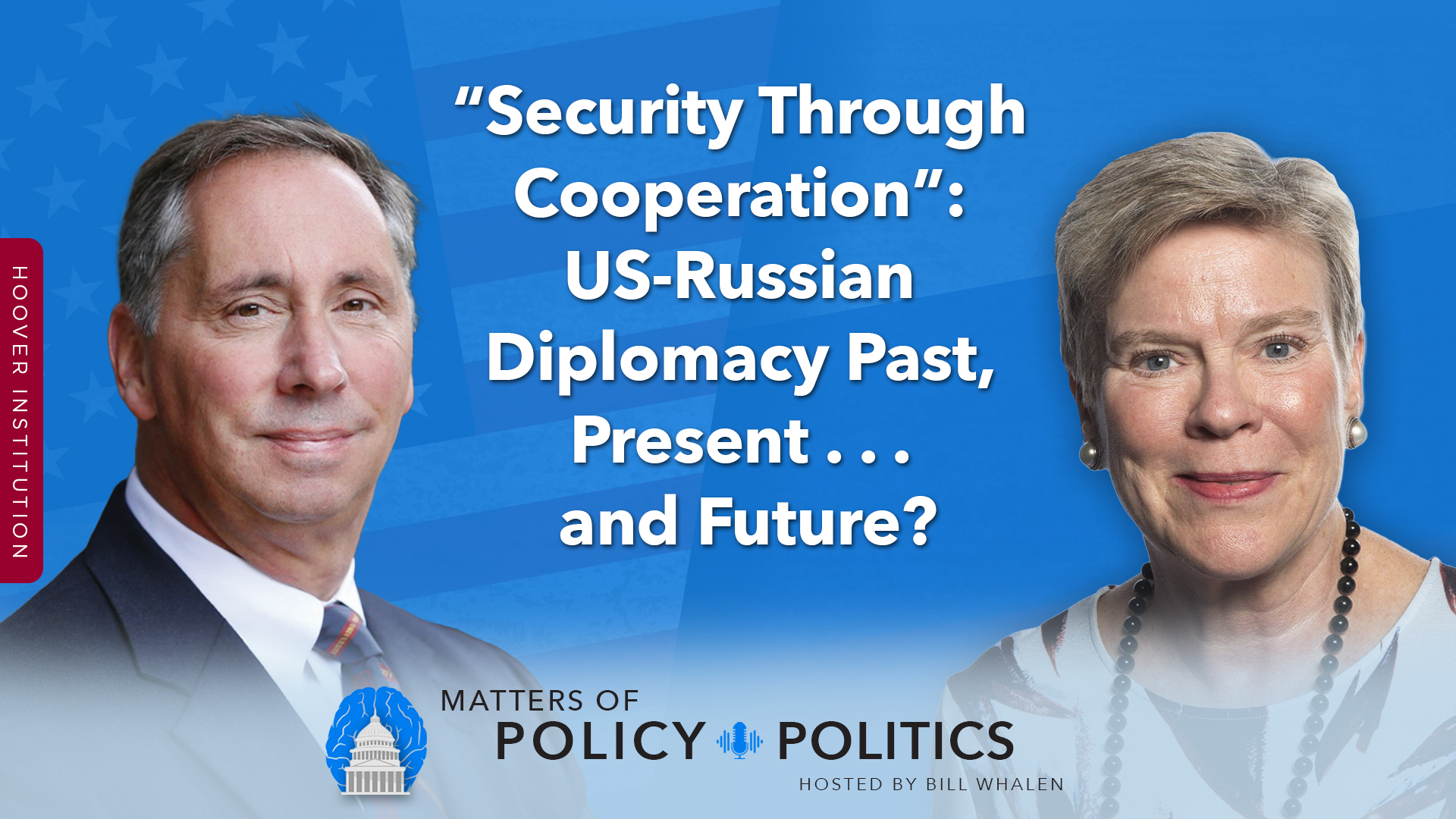
Before invasions of Ukraine and Crimea and various “resets” of America’s diplomatic approach toward the Kremlin, there was the “Boris and Bill Show” – two chummy and newly-installed presidents meeting multiple times at the tail-end of the 20th Century with the shared goal of bringing Russia into a post-Cold War world order as a peaceful, prosperous (and non-proliferating) society.
Rose Gottemoeller, a Hoover Institution research fellow and former Clinton and Obama administration national security aide, sets the record straight on the Clinton-Yeltsin summits, what she learned as the first American woman to lead nuclear arms talks, why Vladimir Putin went from offering help in the aftermath of the 9/11 attacks to seeing America as a threat Russia’s security, and the challenges of serving as NATO’s deputy secretary general during the first Trump presidency.
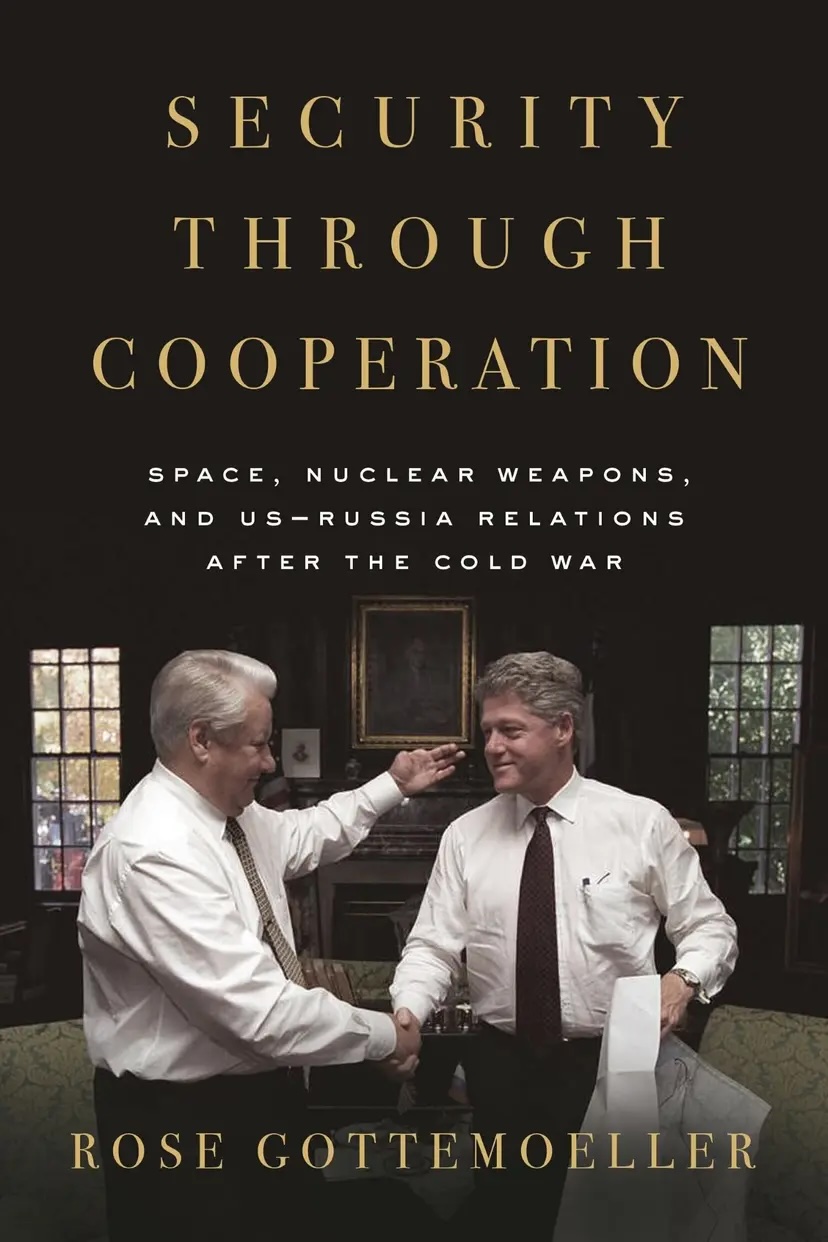
It’s all chronicled in her new book, Security Through Cooperation: Space, Nuclear Weapons, and US-Russia Relations after the Cold War, a must-read for history buffs and students of the enigma that is Putin and the Russian mindset.
Recorded on April 28, 2026.
- According to Condoleezza Rice, one of the hardest things about diplomacy is to put yourself in someone else's shoes without compromising your own principles. Coming up next on matters of policy and politics, we'll speak with the Hoover Fellow and Stanford scholar who's negotiated arms treaties, and was an eyewitness to a new era of diplomacy between America and Russia. She's going to tell us what happens when great power sit down and talk. You don't wanna miss this. Rose Gottemoeller is a research fellow at the Hoover Institution and a lecturer at Stanford University, Freeman Spogli Institute for International Studies, and its Center for International Security and Cooperation. Before coming to Stanford at Hoover, she served for three years as Deputy Secretary General of nato. That's 2016 to 2019 during the first Trump administration, and five years as the undersecretary for arms control and International security at the O Department of State advising, the American Secretary of State of Arms Control, non-proliferation and political military affairs. And as Assistant Secretary of state for arms control verification and compliance. In 2009 to 2010, rose Gotti Mueller was the chief US negotiator of the new Strategic Arms Reduction Treaty. That's called New Start with the Russian Federation. She joins us to talk about her remarkable career, which is told in her new book, security through Cooperations, space, nuclear Weapons, and US Russia Relations after the Cold War Rose. It's great to see you.
- Thank you, bill. It's great
- To
- Be here. I
- Think I need to correct myself. It is actually the Honorable Rose Gotti. It is the
- Honorable Rose Godell. Yes. Once you're confirmed by the Senate, you are always the honorable.
- Now, when you go back to your college reunion, I don't wanna talk about college here in a minute, are you the only one in your class who is an honorable or are there others?
- Oh, I don't think so. I was at Georgetown in the 1970s and I think many of them went on to successful government careers. I haven't taken count, but I don't think I'm the only honorable by any means.
- Speaking of Georgetown, it's a 1970s or a little past this era, but have you read the Bill Clinton biography first in his class by David Moranis?
- I have not, no.
- Oh, you haven't? Oh, you should read this. It's one of the first Clinton biographies to come out. Mors is a Washington Post report at the time. I love David
- Moranis.
- Yes. Wrote a great biography of Vince. Vince Lombardi, I believe, and Woody Chronicles is Bill Clinton at Georgetown.
- Oh geez.
- I
- Really do need to read it. He was a little bit before my time, but nevertheless, he was
- About class of 68 I think or something. Yeah, it
- Was actually the first class where women were allowed at Georgetown, so
- Oh, I didn't know that.
- He was, he was there with his friends of Bill included some, some women.
- Yeah. The way Morans explains it is you went to Georgetown and there was Bill Clinton in his freshman class waiting to greet you. He was politician from day one. I know that's true. I mentioned Georgetown because on this podcast I always like to ask fellows their background and how they got to where they were, and oftentimes it is a roundabout journey. The classic example of the Good Fellow Show with John Cochran, the economist, John, went to MIT and studied physics, not a traditional route to economics, but he took it economics class and just it clicked and he liked that. But your background, you're kind of on path to where you ended up, I think, because you attended Georgetown School of Language and Linguistics and you were a Russian major, correct?
- I was. I was really, I always call myself a Sputnik baby because I became aware of the possibility of cooperation between the United States and USSR way back when the space race began at the end of the fifties, and the Soviets beat us to launching the first satellite, artificial satellite into earth orbit. My dad though, in Columbus, Ohio, was fascinated by this, and as a small child, he took me out into our front yard and said, look at that little dot up there. It's a satellite, and the Russians launched. It Isn't that great? So my dad was not this kind of fisticuffs, you know, we gotta beat him at everything. I, of course, he understood that they were, you know, possibly the aggressor against us, but he was excited by the science and that, so that informed my thinking very early on.
- Okay, now we're getting into another movie, October Sky. You've seen that. Oh, I
- Love that movie,
- Right? Sputnik as well. Yeah, it's the same thing, but that's nasa. But we're gonna talk about space a little bit in this podcast as well. So you ended up in the Clinton administration. What was your, what was your big break to get in the Clinton administration? Did you have a mentor? Were you just the right person in the right place? Had you known somebody for decades? How, how did this come about?
- It was a really lucky break. I was at Rand Corporation at that point, and I'd been working there for over a decade. Wonderful experience. It's how I actually got into working in the arms control space, because my mentor, there was a fellow named Thomas Wolf, who's the senior Soviet military analyst.
- Not the Thomas Wolf,
- Not not the Thomas Wolf who writes other kinds of novels. But when I came to Rand Tom Wolf was writing a book on the first strategic arms limitation agreement called The Salt Experience and those negotiations. So he, you know, he got me into the field and then after his retirement I stayed on at Rand. But by the early nineties, I was ready to try something else, but I didn't quite know how to get into this kind of political world. I'd been a researcher at Rand, but luckily I had a very good friend at the time, Jan Nolan, who has now left us. But she was really a great, a great analyst and a great policy wonk, I would say, in the world of, of nuclear issues. And she came to me and she said, you know, look, rose, I've got a new baby at home and I can't really take on this job that President Clinton's asked me to do. Heading the Arms Control and Disarmament Agency transition, the transition team from, you know, when Bush was going out and Clinton was going in, there was a period when we actually kinda worked together in a friendly like way. And so I was asked to head up the transition team and it was Jan Nolan who said, can you do this for me? I've got a young baby at home. So I owe a lot to my fellow woman, Jay Nolan,
- Before we get into the book. And I really did enjoy it. It is a wonderfully written book. Explain a little bit about where the United States and Russia stand in 1993 and maybe take us through chronology rose of when the wall comes down, when the Soviet Union seeks to exist, and what the situation was that you and the Clinton administration were looking at when you walked into office in January of 93.
- Absolutely, and I give George HW Bush and his administration huge credit because when the wall came down in 1989 and then into the period when the USSR was collapsing up until December of 1991, they were thinking about ways to how, how are we going to ensure a smooth transition here? And yeah, Bush made some mistakes. There was the famous chicken key of speech where he went to the Ukrainians and said, don't try to, you know, escape from working with Russia. You gotta stick with Russia. And the Ukrainians basically said, no, we're headed for independence. But in general, George HW Bush, secretary Baker, his secretary of state, James Baker and others in that administration said, we have got to figure out a way to smooth this transition to, we all hope democracy because they've got a lot of nuclear weapons, they've got a lot of military power that's on the, you know, that could go really wrong if nuclear weapons fell into the wrong hands. Or somehow it turned into this collapse of the system and, and things were escaping into the black market. That was the downside. But the upside was, there was a lot of opportunity there. Obviously gas and oil always at the head of everybody's list, but let's think how we can bring the Russian Federation into the western market world and figure out a way that yes, we can benefit. But I don't ever think there was a thought of not helping the Russian people benefit as well in that period.
- And were you able to fall back on history at all to help navigate this? Did you look back at the Marshall Plan or other past instances where the United States helped a, like as we call it, a downtrodden country?
- I think both President George HW Bush and then President Clinton when he came into office, we're looking back to that history, the really, the collapse of Europe at the end of World War ii. Terrible destruction everywhere. How to rebuild, how to ensure that these countries essentially did not fall into anarchy. So that was a consideration. I think definitely at the time for me, you know, I was a very small cog in the wheel. I guess I was thinking in historical terms, but I was mostly excited as a expert on the USSR and the Russian Federation. We used to call ourselves sovietologists. I was just excited at the opportunity for more intense joint cooperation. I thought it was a great moment.
- Now they're sovietologists and then they're also criminologists. But a criminologist is more involved in sort of the political intrigue of the government
- Reading the tea leaves of what's going on in the poll bureau who's on top of the, on the central committee, right at the top of the Communist Party at the Soviet Union. And I considered myself a, a broader ranging expert because, and particularly 'cause I was focused on nuclear weapons and nuclear weapons policy.
- Right. So a colleague of your, in the book you mentioned had a wonderful phrase for what you were doing. It was called the NERD Agenda. Yes. What was the NERD agenda?
- Well, when I came in and we began to think about how we were going to be working with the Russian Federation, there was this whole set of issues having to do with the economy, financial arrangements, how we get big US corporations like ExxonMobil, working with big Russian oil companies, gas prom, et cetera. Were already in existence at that point. So that was the economics agenda. But then on the other side, there was this huge agenda associated with technology cooperation, and it very much had to do with nuclear weapons because again, we were very worried that nuclear weapons or nuclear material that could go into nuclear weapons could fall into the hands of, of terrorists could fall into the hands of unscrupulous people who would be selling it around the world. And so we were quite worried about making sure that somehow the nuclear assets of the Russian Federation were protected. That was number one. But number two, there was a large sense of technology cooperation that could be mutually beneficial in space. And that goes back to that Sputnik moment we talked about a few minutes ago. And throughout, despite the space race, the race to the moon in the 1960s, there was steadily a kind of quiet cooperation going on between our National Aeronautics and Space administration, NASA and the Soviet Academy of Sciences, quiet co cooperation, developing right along until the 1970s, which was the first moment of Deante between the USSR and the United States. And that's when we got the first Strategic Arms limitation agreement, but also the first big US Soviet space cooperation. It was a docking episode between the Apollo and SAS capsules. It did have a practical reason if Soviet cosmonauts were in trouble in space, we could come rescue them and vice versa. So it had a actual pragmatic reason, but it was also a great moment to shake hands in space.
- Big photo op right as well. So the book Security Through Cooperation, I read it. It is a good airplane book it, why do I say that? Because you could read this flying across the country and get through it quite easily. Who's your audience here? Are you writing this for students? Are you writing this for people like me who like to read about history and bios? Are you, are you writing this sort of set the record straight on the past 30 years? Who, what's your intent here?
- My first intent sprang from the fact that I was growing very impatient with some lines coming out, particularly from the Kremlin, saying that from the very outset, the Clinton administration and President Clinton himself was dead set on expanding NATO to the borders of Russia in order to threaten aggression and indeed the existential defeat of the Russian Federation. That was not my memory at all. And I worked intensively with President Clinton in his first years in office. I know that he actually, as a first idea said, we must have an abiding security, economic and political relationship with the Russian Federation, otherwise we will not have peace in Eurasia. He had that as his first big idea and he reached out to President Yeltsin very early on. His first phone call with a foreign leader was with President Yeltsin. And I, I was a note taker for that phone call. So there was, I, I would say that view was very firm and it was a view of there's something positive from both of us in this cooperation. And so the notion somehow that this is, this is a period when the US was out to get Russia really, really struck me as very unfair and very, very unfortunate. So I decided I needed to set the record straight. That was the first thing. But also I thought it was a period that doesn't get enough attention because there's a lot of attention to the details of NATO enlargement and rightly so. There've been some great books on that, but nobody's written about the other piece of the action at that time, which was this period of deep cooperation between the United States and and Russian Federation. So I also wanted to get that history out there for buffs, for history buffs for people who would be interested. But then third, I started thinking about the future. Are we going to be better off once this terrible war in Ukraine is over, essentially walling off Russia forever and defending against them? Or at some point, are we going to want to think about what cooperation could be like in the future with the Russian Federation? Not now, not this moment, but in the future. So I thought, well, this could also be a help for policymakers as well. I hope to think about that future.
- Now, you mentioned you were taking notes during the calls. Would that make you technically a interpreter? Not a translator?
- No. By no means, and in fact I am,
- Is there a distinction between the two? Right.
- There is, but it was not apropos here. We always had official linguists on the line. I'm no official linguist. In fact, the reason I went from working toward a, a, a translator or interpreter career at Georgetown to being more interested in policy was I realized two things. One, that my Russian was never going to be native speaker level of Russian. And number two, I wanted to be down on the UN conference floor. I didn't wanna be up on the in in the interpreter's booth. I wanted to be in the middle of the action. So I kind of changed my view early on. And so I was there taking notes for President Clinton as a young, essentially policy assistant to him, a member of the National Security Council staff.
- And your notes were just point by point what Yeltsin was saying, or were you also trying to interpret how he was saying it?
- Well, both sides taking notes on both President Clinton and, and President Yeltsin. But also then yes, taking notes from time to time, making notes of how I was lucky in that I understand Russian and I could note down if he used a particular turn of speech or, or sounded a bit agitated about something, I could pick up on that a bit better maybe than somebody who didn't speak Russian. So it was beneficial that I'd spoke Russian, but not official linguist by any means.
- Great. So let's go back to 1993 and let's talk about the situation these two gentlemen are facing. Bill Clinton is conducting a balancing act here. He wants to bring Russia back in the world community, he wants to help Russia, he wants to help it rebuild. He wants to turn it into a peaceful member of the world. But at the same time, he also wants to expand nato. Correct?
- Well, it's very interesting that his first objective was this relationship with Russia. He was convinced of that, I think partially talking to George HW Bush, that transition period, partially talking to Richard Nixon, interestingly, because Richard Nixon, although he had left, Nixon,
- Passed his, yeah, Nixon passed his way in spring of 94. So this
- Last year, exactly, so his first year in office 93, president Clinton met several times with President Nixon to talk about this. And Nixon was very committed to making this kind of smooth transition for the Russian Federation. And he was traveling to the Russian Federation during that period several times. And so I would say President Clinton's first conviction was establishing this relationship with Russia. And then only later, over a period of the 93 in the 1994, was he hearing from people like Lech Esa, for example, the president of Poland and Vaslav Haval, the president of the Czech Republic. And they were pushing hard on NATO enlargement, but he only became convinced of that, I would say later on.
- So those are Clinton's competing concerns. But then Boris Yel, and my goodness, he has, he has an economy, he has to figure how to, how to revamp, reboot, and grow. He has the problem with loose nukes as you talk about in the book. He has political pressures because he's in that job, but it's not exactly a secure job as well. So he's under the gun a lot as well. So is it fair to say that actually Clinton has an advantage over Yeltsin in these conversations?
- I would say that Clinton had an advantage over Yeltsin, yes, because there was a more settled situation in the United States at that time. It was just at the fall of the wall and the breakup of the USSR, the US was emerging as, you know, the big winner here in the post Cold War. The victory was in its hands, so to say. At least that's how we interpret it. Now, at the time, again, I remember it as being all about trying to figure out a smooth transition and figuring out how to ensure stability going forward. I don't remember this kind of triumphal list approach, but that is how some people have described it. In effect, I think we were in a advantageous position because stability was on our side. And economic health, more or less was on our side. In, in Yeltsin's case, obviously he did have chaos that was affecting him and in particular, political crisis. And in that first year we were working with, with Yeltsin, he had to essentially shut down his parliament. And he did so in a violent way by shooting, bringing the tanks out, parliament, and Exactly, exactly. Setting the, the parliament building on fire. So, so was a very turbulent period in the Russian Federation, no question about it.
- But at this point, Jossen iss working on the assumption I need the United States, but we'll get to Putin here a little later in the podcast because Putin has now come to a different feeling towards the United States. Talk a bit about the, the so-called Boris and Bill show, how, how organic was it, was it, we read all the time, they really liked each other. They joked around, they piled around. There was kind of a bromance between the two. If you get the book, there was this decidedly nineties photo on the cover, and I say nineties photo because this is what you did in the nineties. You took off your jackets, you look kind of casual there, there on their fine white shirts, kind of yucking it up. Was it, was it genuine?
- Absolutely. I, I really think that the two hit it off. There were personality traits between the two of them. They both had large personalities, big outgoing personalities, and that helped them, I think to hit it off. They both had great senses of humor. They loved to tell jokes back and forth, you know, Russian jokes, English jokes, but translated back and forth and they would just laugh ply. They really got along together very, very well. But they were also very businesslike when it, when it came right down to it, when we had the first summit meeting between the two of them in Vancouver, British Columbia, and April of, of 1993, here's just an example of how friendly they were. They got along so well. Bill Clinton invited Boris Yeltsin to join him in the big black limo to drive to one of the meetings. And I was asked to come along and sit there and kind of, I said I wasn't an interpreter, but kind of to informally translate between the two of them. There wasn't an interpreter in the car at that moment. And Bill was so enthusiastic, said, oh look, Boris, it looks so great here in Vancouver. They've hung all these Russian American flags up. And Y had said, oh yeah, bill, that's, that's great. I I love the fact they put up all the flags, but they hung them upside down. So, so it was very, very funny. I, I guess the, the city fathers hadn't quite figured that out. But in any event, it was that kind of immediate hitting it off that they were able to tell jokes together and be very frank with, with each other, which came in handy also.
- So you were in the car with them. Very cool. You look at this period of history, and by that I'm referring to 1993 to 2017, these are the presidencies of Clinton and Bush 43 and Obama and sensing Rose. You look at those 24 years and three women service Secretary of State each one term, and that's Madeline Albright and Con Lisa Rice, whatever happened to her. And Hillary Clinton,
- I'm glad she's still around.
- Exactly. And she studied Russian as well as, as a young person, I'm always cared about this per do you, do you just like to do difficult things? Because I've studied, I took Latin and Spanish and high school and Spanish is easy. Russian is not easy though, do you? Well it's, do you seek out difficult things or
- It's not as hard as Hungarian? You know,
- You took it in high school, didn't you?
- I did. And once again with, we talked about the space raise a little bit. There was a fair amount of hysteria in the United States after the Sputnik launch got off. And so
- The building of fallout bunkers went, was gangbusters in 1958.
- Right. And so the federal government pumped a lot of money into stem, what we call today, STEM science and math studies. And they also pumped a lot into language studies. So even in my high school out in Columbus, Ohio, there was a very intensive Russian language program.
- What I'm getting at is you had three prominent women as Secretary of State, very prominent jobs, but talk about women being represented further down the diplomatic rank. So you're talking for example, about interpreting in doing that, that's not quite secretarial or administrative, but it's not the same as being at the table doing policy. As you later would during arms talk, so back in the nineties, were women part of the process or not
- Starting to come into the process? Yes, and I would say the 1980s, seventies was the period of real struggle. I think it was in that era that if a woman got married, she had to leave her post in the foreign service and could not stay on. And the foreign service women fought that really hard in the seventies and, and so changed that policy. So the struggle was a steady one. I went to work at Rand Corporation in the late seventies. There were several other young women who were being brought in from university programs. And so we were coming up through the ranks and it was very specifically with the view that we should be doing policy work,
- Right?
- And should be intensively involved eventually in, in government inter-agency activities. But, and not, I stress not just falling into the secretarial ranks. Indeed, there were some very good women I worked with who used that period of the 1990s to take a jump up from the secretarial ranks and become more policy oriented experts through that period. So it was a period of rapid change, I would say from the 1970s into the 1990s, by the time I arrived as the director on the National Security Council staff in the Russia Affairs Division, so to say, there were a number of women working in similar positions at, at the sta sorry. There were a number of women working in similar positions in the National Security Council staff
- In the book you gave passing mentioned to working in the White House, or I guess the NSC at the time. And that conflicts with a 10th birthday party.
- Oh, yes, yes. We were of the generation who could have it all right. So working, having children, everything happening smoothly and perfectly. But the Vancouver Summit happened to coincide with my son's 10th birthday. So I asked Tony Lakes and the National Security Advisor after the summit was over, I said, may I take a few days off? My son is celebrating his 10th birthday. He is here with his grandmother in California. We were already in Vancouver. Right. Just a quick hop down. So Tony said, yeah, if you must, so I went off and celebrated the 10th birthday party. I found out later that NSC staffers never, never ever leave the presidential party during a summit trip. So I had committed a huge faux pa luckily, I guess I was forgiven at because I was the one working on this nerdy agenda of nuclear weapons in space and nobody else wanted it, so they didn't steal it from me while I was gone.
- So the Bill and Bo show takes us all over the world. It takes us to Vancouver, as you mentioned, they famously meet at Hyde Park, not ex, but Clinton really wants to play the FDR card and talk about, you know, FDRs legacy in terms of diplomacy. They meet wells, they meet in Istanbul, I believe. Where is Boris Yeltsin by the end of this? By, by the end of the 1990s, if you will. Let's talk about the relationship and what's happened in politically and also physically just dealing with Boris Yeltsin. Is he, is he just worn down by then?
- Yes, sadly, Boris Yeltsin, it's no secret, had a drinking problem. And as
- Well on the book he mentioned Strom Talbot, I think makes his passing mention about after, after lunch, I think the words he says is, it's problematic,
- Right? It's problematic. And indeed, president Nixon on one of his trips to Moscow saw how Boris Yeltsin was beginning to collapse under the weight of his alcoholic consumption. And so there was a real sense that Yeltsin's Health was not going to hold up for too much longer. And indeed, that, that proved to be the case by the mid 1990s into the latter half the 1990s, his health was a a serious, serious problem. I did wanna talk a bit about the role of his prime minister, though Victor Cherna Mein, who was a remarkable,
- Remarkable player. I want you to, because I think this is an important part of the book, you talk about how the president, how Bill Clinton and Al Gore are working, and then how the Russian president, the Russian Prime Minister, talk a bit about the difference in terms of how the President Prime minister work in Russia versus the president, vice president in the us.
- Well, at that time it was a kind of developing relationship, honestly, because we'd had the Soviet Polyp Bureau before then, right? And it operated quite, quite differently. But they went to the model that exists throughout Europe of having a president who's more or less the titular leader of foreign policy security policy, et cetera. But the Prime Minister is the chief minister across the interagency, heading up essentially all the government departments and so responsible for making sure that the trains run on time. And in the case of Victor Cherna Mein, he'd come out of gas prom, he'd been a very successful business executive, even in the Soviet era. And as the Soviet Union was starting to collapse, he'd gotten through that period. And so he came into this Prime Minister role with a lot of experience, as I put it, pulling the strings and managing what was a, a very disorganized interagency in Moscow, at least to begin with, after the end of the Soviet Union. So he was, he knew everybody, he knew who to call, he knew who to get in touch with to make a problem go away. So he was a very effective player. And it was in that role specifically of, of knowing how to manage the strings of government.
- Now it's Istanbul. I think the meeting between Clinton Yeltsin there, where Boris Yeltsin tells Bill Clinton, next guy coming in is a guy named Leonard Putin, but he's okay. He likes democracy, he likes working with the United States. And you're nodding your head because in the year 2000, Vladimir Putin did wanna work with the United States.
- It was very true. I think, honestly, I remember Al Gore meeting with him. He was the last prime Minister whom Al Gore met with in this, it was called the Gore Cher Medan Commission. And then there was a series of several more prime ministers. And the last prime minister before the end of the century was Vladimir Putin. I do remember that, that Vice President Gore got some bad vibes from Vladimir Putin. They did not hit it off.
- He looked at his eyes,
- Did not look in his eyes, but then President George W. Bush came in and George W. Bush again to his great credit, was determined to try to continue to develop a stable relationship with the Russian Federation. People have criticized him for looking into Putin's eyes and seeing, you know, a soul. But, but honestly, I, I do give him huge credit for wanting to have this stable relationship in the interest of larger security and stability in Eurasia. He went outta his way, president Bush, to invite Vladimir Putin to come even to his ranch in Crawford, Texas, to famously cut brush with a chainsaw to enjoy Texas barbecue. And, and at the time Putin was responding well indeed, we always talk about how Vladimir Putin was the first leader who reached Bush on nine 11 and offered the help of the, of the Russian Federation if we needed help in our own defense. So it was quite in the early part of the, of the century, first years of the decade, it was, it was quite an honest effort, I think, to develop cooperation. And it was an honest effort, I believe, on both sides.
- Right. But here we are, 25 years later, rose, and in your book chapter five, you write about what you call the Putin conundrum. And that is the question of this guy who in the early two thousands wants to cooperate the United States and is on our side after the nine 11 attacks. And now that Putin is gone. And you have some theories here, and I want you to quickly go through each of these theories as to what happened to Putin. Number one, he's affected by the United States withdrawing from the A BM treaty. So that's one thing you posit. Secondly, a political rival of es,
- Right? Well, in the end of the day, I don't actually think that the withdrawal from the A BM treaty was, at least at the moment, such a big deal for the Russian Federation. I recount in the book at the time I happened to be in Moscow, I was working at the Carnegie Moscow Center at the time, and I was invited to meet with a former chief of the general staff, Marshall Sergei, if his name was at the time he was retired, but a military advisor to Putin. So I go into the Kremlin, I had to wade through snow drifts to get there. It was a very snowy blizzard going on in Moscow that day. And I thought, ugh, this was the day that Bush notified that they were going to withdraw from the A BM treaty. And I thought I would get the coldest that I would get the coldest reception, just like the snow outside. And instead, when I got into the meeting, Sergei responded in a very sensible way, basically said, we're not gonna overreact to this. We'll take steps to defend ourselves of course, but we're not going to overreact to this withdrawal.
- I'm curious is, is the Russian style to be cold or to browbeat?
- Both.
- Both.
- They're very good diplomat, depending on the, they're very good. They're very good at negotiating. If they need to browbeat, they will. If they need to be give you the cold shoulder, they will. If they need to turn on the charm offensive, if they will, they're very good at all those things.
- Alright, your second theory, political rivalry, McHale Koki, did I get koski right or did I BoJack? Well,
- I would see mic koski. But anyway, this was a period between 2000 and 2003 when Kovski was becoming a very successful businessman. Russia's richest man. And he decided to use some of his money to establish his own political foundation to establish a kind of think tank. I even remember going to Moscow once, invited by his foundation to do like a conference there and talk about the future of Russia, et cetera, et cetera. Well, this possibility that one of the new business men, the newly minted oligarchs could emerge on the political stage, really seemed to get under Vladimir Putin's skin. And so by October of 2003, he had Kosky arrested and sent him into, essentially into internal exile. He spent many years in and out of prison and camps and then ended up going abroad at the end of it. So I think that that was really one of the most important moments for Putin, this domestic reason that is that he did not want to see rivals appear. And that means he did not wanna see true democracy appear in Russia. And that that troubles me very much. But that's the way it was.
- Right. And your third theory food is very affected by Europe's color revolutions, in particular the Orange Revolution in Ukraine. And spend a minute explaining what the Orange Revolution is and how Putin sitting in Moscow would look that and think, oh my goodness.
- Yes. There are actually two critical periods in Ukraine's history. The first is the Orange Revolution at really at the beginning of the century and then a decade later, the maan so-called Revolution of Dignity, inky. But I really think that it was the Orange Revolution in early on that led Putin to conclude that Ukraine was heading in a different direction. They were not going to accept the candidate for president that the Kremlin was trying to foist on them. They were not going to accept this political strong arming from the Russian Federation. They were heading off in another direction, which was a pull toward Western Europe and toward true democratic practice. And I really think that this was a huge wake up call for Vladimir Putin. It was the first time he recognized that the Ukrainians may be heading off in their own direction and he could not exercise that kind of influence over them.
- And how many years later did he then go into Crimea?
- Well, it was just about a decade later, honestly. We had then the Euro Myan, so-called the Revolution of Dignity, 2012, 13, that kind of period. And a year later in 2014, the spring he marched into Crimea. So that was, that was a very, very stressful period. It's always interesting to me though that, and, and here again we hear complaints constantly outta the Kremlin about NATO these days. But it was at that time the European Union, that was the tension point because the Ukrainians were trying to sign an agreement for cooperation with the European Union. And that set Putin off and that led to this, this standoff in the revolution of dignity. And I think eventually then impelled him or inspired him perhaps to seize Crimea and to start the war, the civil what became the Civil I, I call it a civil war in the Donbas, the eastern provinces of Ukraine.
- Alright, so V letter and Putin is both the quandary headache for George W. Bush and Barack Obama who you work for. Let's talk now about arms control and about the new start negotiations. And you are the first woman to lead negotiations, correct? Yes. You
- Well, nuclear arms control,
- Nuclear control, glass ceiling shattered. So
- Well one of them anyway.
- Okay. Why were you the choice? Why did they pick you?
- I think a couple of things. First of all, I had the good fortune to have been working for many, many years in the nuclear policy arena, starting with a very good grounding working at Rand Corporation for over a decade in the seventies and eighties. So I had a really good grounding in the nuclear arena, both policy on the US side, but also the USSR and Russian Federation after it. So I had a lot of sub substantive experience that people knew about. Furthermore, I had the good fortune to actually live and work in Moscow for three years just prior to Obama coming into office from 2006 to 2008. And during that period, I organized a regular round table with Russian experts in Moscow to talk about what should the next deal look like. And I would bring experts from both sides of the aisle. I was still thinking in bipartisan terms, I think that's the best way to think. So I was bringing experts from the Republican party experts from the Democratic party. I didn't know who was gonna be elected in 2008. I said, let's talk, what do you guys want? What do you guys want? And so trying to convey to the, to the Russian side what some of the options may be. That was a great preparation for me. And because I asked so many people to come to Moscow, they knew essentially that I was well prepared. So I think that was a factor too.
- So in the late two thousands, in the late first decade of the, of the 21st century, you would've had the advantage of having people who had been involved in salt back in the day to tap into maybe explain the difference between salt and the start here, by the way, people maybe are thinking both are the same, but what a, what is the difference between the two treaties?
- Right. Well salt wasn't actually a legally binding treaty, it was an agreement.
- Strategic arms limitation, treaty
- Limitation. Well that's, it's actually strategic arms limitation talks.
- Talks. And so it's the salt, it's several
- Agreement,
- Several versions of it, right?
- It's, it's very confusing. But yes, the first two that we negotiated during that period of detton in the 1970s was salt one was signed and concluded in 1972, and then salt two, which was more ambitious. And the idea was to really kind of limit the force structure, not actually focus on reductions, just limit what was already in place. And prevent
- Reduction is the RN start.
- Is the RN start. That's exactly right. So we were working on limitations in the 1970s and then a new technology came along called multiple independently targetable reentry vehicles or mfs. And that meant that you could have a missile if you were limiting missiles, you could suddenly put in the case of the SS 18, we feared maybe 15 warheads on top of that thing. So suddenly you had a single missile that you were limiting, but a lot more warheads that you weren't limiting. So that's when people said, okay, we've gotta start reducing instead we can't just limit, we've got to reduce. And that was, I would say, a, a technological development on both sides that led to a change in philosophy about how we were negotiating.
- And what was your negotiating style?
- Well, I have a very deliberate style and a very calm demeanor. That's my personality anyway. And I tend to keep, you know, just keep talking and keep describing what we needed and keep delivering my talking points. And it did lead to some stresses and strains with my own delegation. It's interesting, we were in the very earliest phases of the negotiations in, in 2009 and it was, you know, summertime into the fall. We were beginning to sit down with regular negotiations going on in the fall of 2009. And my own team got kind of nervous that I wasn't showing enough temper.
- Is it as simple to say that being a good temple of matter, of being a good negotiator involves being a good poker player?
- Yes, I think that's part of it. You have to be able to be very, very circumspect and very private about what your final objectives are. You have to hold on to them carefully and dole them out and return for concessions on the other side. But you also have to know when to call forth concessions by showing a little leg on your side as well. So it's, it's not exactly the same as a poker match, just because there are so many moving parts and pieces in a strategic arms negotiation.
- Is it similar to being a devious blackjack player in that you have to count cards? Kind of guess what is coming from the other side?
- I think that's actually, that's more apropos. I think black, I never thought about it before, but I think blackjacks actually a better example. And particularly because you know that they needed to make a concession over here, say on the number of warheads. And we probably have to make a concession over here on some language related to missile defense. So you know, you have to do trade offs across a very wide range of issues. Alright,
- We have taken your journey from Georgetown. We have gone to Vancouver with Boris and Bill, we've gone to Moscow with Carnegie. We now have you negotiating. There's one more stop. We should talk about Brussels. Why nato?
- Yeah, that is a good question. I have to say I was astonished. I was under Secretary of State for arms control and international security at the time. I had never really worked at nato and in fact, most of my career had been made up doing bilateral negotiations and bilateral cooperation with the Russian Federation and other states of the former Soviet Union. So all of a sudden one day I get a phone call from a senior figure in the State Department who asked me, would you be interested in going to NATO as a Deputy Secretary General? I said, why me? I was really quite curious. And the view was,
- And what year is this?
- This would've been 2016,
- 2016, interesting political year in the United States,
- Right? So I said, well, after back and forth a little bit, I said, well, yes, I would be interested if, if the president would like to put my name forward, of course I would be interested. So then there was of course the normal inter-agency deliberations back and forth. But eventually President Obama wrote a letter to Secretary General Stoltenberg, who was head of NATO at the time, yen Stoltenberg, and said he was putting me forward as the US candidate. There were other candidates from other countries and I wasn't the only one. So it was a competition.
- So that would've made you the highest ranking American in NATO at the time, at 20 at,
- Yes.
- In 2017 when Donald Trump comes to office.
- Correct.
- That, that
- Was a very exciting time.
- Does that make you something of the javelin catcher at nato?
- Well, it's interesting because when Trump arrived in office for a while, there was a bit of a threat that somehow he would try to pull me back from nato. I was not there as a State Department employee by any means. I had left the State Department and had gone as an international civil servant to nato, which turned out to be a wise decision because Trump didn't have any real legal means of pulling me back. But he could have made it tough for Stoltenberg to keep me on. But in the end of the day, that worked out, there was an advantage to me being there as a US senior, senior civil servant because I could essentially talk to Washington, help with the early warning about what was coming next with President Trump, but also be a, a, a senior representative of NATO in general in, in trying to describe the utility of NATO to the United States. That's when those questions first began to arise.
- There are at least two lines of thought regarding Trump and nato. One is of course, bull and China shop. You just can't treat your friends and allies this way. You can't be as unfiltered. You have to be, for lack of a better word, more diplomatic, more tactful in what you say. They're the school of thought, though. The guy's gotta point, the country's not pulling their load.
- Well, certainly y certainly Ys stoltenberg and I always felt that way at in the first administration because at the time the allies weren't pulling their load. They were essentially freeloading on the United States, and this is nothing new. Jack Kennedy complained back in 1962 that the allies were not pulling their fair, paying their fair share, they were not pulling their load. And so every president since has complained about that. It was finally Donald Trump with his threats to withdraw the United States from NATO with his threats not to fulfill the so-called Article five commitment to help in the defense of nato, should there be aggression. He was the one who got them to finally wake up, and that was done during his first administration. And so they started to spend 2% of their gross domestic product on defense. That was a promise they had made way back in 2014 when Putin first invaded Ukraine and they were not responding to the promise they had made. So Trump got them to wake up and olberg, and I always felt that that was a, a good thing that he did.
- What is the health of the Trump NATO relationship right now in your estimation? Yeah, the NATO sec. The NATO Secretary General was in Washington last week.
- Right, Right. Well the president is obviously very disappointed with individual NATO allies who haven't stepped forward to support and help him with his war in in Iran. Yeah, and I think it's, it must be really emphasized here that there's a difference between NATO acting as NATO on a consensus basis and individual NATO countries helping out with a US initiative somewhere, policy initiative or, or conflict, whatever it may be. We faced this before when George W. Bush invaded Iraq back at the beginning of the century, that many of the NATO allies at the time did not wanna participate in that adventure. So to make a long story short, I think the president is very frustrated with NATO members, individual NATO member states, and he has poured that frustration onto the institution. So he's very angry at nato and he talks about punishing individual NATO members and the talk about withdrawing from NATO again comes to the fore. So it's a period of frustration, but I wanna say again, Donald Trump, he started the ball rolling in terms of getting the NATO allies to take responsibility for their own defense. I think that's a good thing.
- Okay, now let's work under the assumption. People are gonna buy this book and read it and they're gonna read about what really happened in the 1990s and the US Russia relationships. So history will be corrected. Let's now look into the future. And I want to ask you three things. First of all, let's stick with NATO and talk about nato. So NATO recently celebrated its 77th anniversary of its founding in 2029. It will be a robust 80 years old. Is NATO adapting to the times we live in rows? Is there a danger that NATO can become the League of Nations?
- I don't think so because the League of Nations never had that hard security structure to it. And what NATO has is a hard security structure that is made up of military operational capacity, a command structure that is formed in, well, it's part and parcel of the ucomm command structure, but it also has an individual and multilateral aspect to it. And also now a lot of hard power, hard capacity that's coming in as the allies, again, get their act together and begin to replace weapon systems that they should have replaced long ago and build new capability like the drones that are proliferating so rapidly now.
- So, so, so you're saying whereas the League of Nations essentially was said the Hagen Tutut things.
- Yes,
- It was nato. NATO has teeth,
- NATO has teeth, it has hard security assets to its name.
- You talk to people in Europe right now, what's their mood regarding this president, the American president? Are they angry? Are they fed up? Are they exasperated or all of the above? Are they, are they playing a long game toward 2028 because you do you just see Americans going over to Europe and talking?
- Yes, exactly. But I think everyone understands there's no going back to the status quo, ante now, and nobody believes that the next president coming in with a different attitude, tornado NATO, is going to change the clock back to, to the time before Trump. I think that everybody understands, first of all that they do need to be taking more responsibility for their own defense. And second, that the, that there is going to be a European nature. Now with Canada, of course we have to remember Canada's a member of nato, but there will be a European nature now to how defense is conducted in Europe. And so that means different grouping around leadership of defense policy. In, in Europe, the US was always premier, enter Paris, always first among equals. And if the US is not trusted as it is not trusted right now, even with a new president coming in, other leaders are going to have to come to the fore. And that I think is the tricky question right now. How will they exercise leadership inside NATO when there's still quite a bit of competition between and among them?
- So what is the play for the next American president in 2029? Do he or she need to go to Brussels and give a talk or at least sit down and talk to the leaders and have a frank conversation about things? And if so, what would you recommend that the American president bring up?
- Well, I hope it will be an American president who recognizes the value of our allies. They are forced multipliers for the United States and always have been. And again, Trump was right to tell them not to, not to drag their feet on, on defense capacity. But I think the, the new president in 2029 will be seeing a group of leaders who are much more ready to stand up and exert defense capacity and defense power and much more capable because they will have now acquired and modernized to a certain degree. So I think in a way the US president at the time can enter into a different kinds of kind of partnership with the allies where may not be comfortable for Washington, but Washington won't be first among equals anymore. But in that way, I think can begin to rebuild that, that trust and rebuild the, the cooperation inside nato.
- Topic two, rose Russia. So last week was the 50 month anniversary of the war with Ukraine. I don't think any of us would've thought 50 months. We might've thought 50 hours, 50 days maybe. But here we are, 50 months, 1,560 plus days into the fighting. Let me run this scenario by you. Let's assume that this winds down one side does not win, but they just stop fighting like Korea, just kind of out of sheer exhaustion. If anything, they've both come to conclusion enough is enough and somehow they reach a settlement in 2027, we can do another podcast talking about what the terms that would be, that would be a negotiating bonanza for you. I think in terms of how to read the Russians, but this scenario Rose, let's say that there is a, you know, a truce, a armistice in 2027. Does Donald Trump need to go to Moscow in 2028? Should he go to Moscow in 2028? I think Reagan went to Moscow last year, didn't he?
- I think it really depends on, on where things stand. And it really depends on, it always depends on what the president needs to accomplish and what the nation needs to accomplish. So what would the goals be at that moment? I would argue that really it's for the next president to make the move in terms of reestablishing cooperation.
- Which my next question, but what is that move Rose? Because look, you mentioned George W. Bush. Look Vladimir Putin in the eye. Was it Hillary Clinton who did the reset button? I mean it's, we've, it
- Was Barack Obama
- Bar Obama, the reset button bar, Obama reset button. So previous administrations have tried different ways to approach this man.
- I think for one thing, my belief is that we cannot really get back into full cooperation with Russia while Vladimir Putin remains in a Kremlin. And I'm not predicting anything about where things go in the coming, the coming years. I'm certainly not in any way suggesting that there should be regime change in, in Russia, it's up to the Russian system to replace their leader. But I do think that in order, because of the way Putin has essentially invaded Ukraine and been so aggressive in his behavior toward Ukraine, but also the hybrid threats against our allies in Europe and against us have been such. Vladimir Putin clearly considers us the enemy. So how are we going to cooperate with him? I think there could be perhaps some pragmatic resumption of, of certain business ties. Gas and oil are always top of everybody's mind. So maybe some pragmatic moves in that direction. But I think to truly get back to deep cooperation with Russia will require a new leader in the Kremlin
- Issue. Three diplomacy. So under Donald Trump, we've seen foreign policy handled by one of our colleagues, sir Neil Ferguson calls the real estate guys Kushner Witkoff going around the world and cutting various deals. This is a departure from previous administrations where D Plum was handled by people like yourself, who I would call professionals at it. And that you were educated at school, you have Chevrons on your sleeve by the time you did it, not the Trump approach. Do you like the Trump approach or not?
- It can work in order to what we can see. We got the ceasefire in Gaza and got the, got the hostages back, right? That would not have happened without Donald Trump and his form of this kind of rapid fire deal making. So it can work, but the trouble is then you have to stitch together the piece. And that's very painstaking work. And we see in Gaza today, we still haven't stitched together the piece and we haven't figured out how do we get back to what really meet needs to be done quickly. And that is reconstruction in Gaza. So that is where Donald Trump's approach falls short, is stitching together all the other parts and pieces that make a deal in the end of the day, successful, successfully implemented. And that requires some people who know some things about diplomacy, yes. But also know some things about technical aspects that need to be tackled and things like reconstruction. Where's the money gonna come from? How's that, how's that fund going to be put together? Who's gonna do the work? And what are the, what are the rules and regulations gonna be so that the money doesn't go down the hole of corrupt practices. So there's a lot that needs to be done to make a deal truly work. And that's, it's funny, I've been thinking about this a lot because in a real estate deal, yes, you make the deal, you shake hands, the checks are exchanged, but you still have to get it across the finish line in terms of all the legalities and so forth. So I think they ought to get that, but they don't seem to,
- I think about it in this regard. We look at our political leaders, president here in California. We had Arnold Schwarzenegger's governor came to office with no governing experience. Real very little political experience, but no governing experience. Not that he was CEO. Donald Trump comes into office without political experience. He has CEO experience, if you will, and you get mixed results when you bring in somebody like that. But I'm curious on the foreign policy side, it would seem to me it would help to have somebody who came up through the ranks. Con Lisa Rice for example. By the time she becomes Secretary of State, she has not only studied foreign policy, she has served on the National Security Council. She's ready on day one.
- Yeah. And I do think that executive experience can be really, really beneficial. It depends on what kind of an executive you are too. Right? Right. Some are real hands-on managers. Oh, temperament.
- Yeah. - And I think, I think that people who realize that it's not that it's a team sport, managing a big enterprise, it's a team sport to get a deal across the table. That to me is, is the key, the key revelation that needs to be top of mind when, when you're talking about who's going to be successful as a policymaker and as a diplomat.
- Alright, final question for you, rose. Somewhere out there, a young woman's gonna read your book. She's maybe 17 years old. She is studying a difficult language like you did in high school. Maybe she's taking probably
- Chinese.
- She's gonna say maybe she's taking Chinese. Yes. Or maybe Arabic, if you will, but she's thinking, I wanna be rose when I grow up. So how does somebody become Rose Coach Muller?
- I always say, first thing is take good risks. When my good friend Jan Nolan said, I can't take this job in the Clinton administration. Would you like to take it? I was nervous to begin with. And I went and talked to my husband. He said to me, you'll never forgive yourself if you don't try it. So I had young kids at home too, but they were in elementary school by that time. So I did it and it was a risk worth taking. So I always say to young people, be prepared to consider them carefully. Talk to your spouse, talk to your partner. Talk to your mentor. But in the end of the day, take good risks because that's how you move through life. That's how you move through a career successfully.
- And one day you'll write a book.
- Maybe so,
- Maybe. So Rose, enjoy the conversation.
- Thank you, bill. I did too.
- You've been listening to matters of Policy and Politics, a podcast devoted to the discussion of policy research from the Hoover Institution, as well as issues of local, national, and geopolitical concern. If you enjoyed this podcast, please don't forget to rate, review, and subscribe to our show. And if you wouldn't mind, please spread the word, tell our friends about us. The Hoover Institution does Facebook, Instagram, and X feeds. Our X handle is at Hoover, its, that's spelled H double O-V-E-R-I-N-S-T. I also recommend you go to our website, which is hoover.org, and sign up for the Hoover daily report, which keeps you updated on what Rose GoTo, Muer, and or Hoover colleagues are up to. And that's delivered to your inbox, weekdays, the book's title again, security Through Cooperation Space, nuclear Weapons, and US Russia Relations After the Cold War. It's out now. Get it while you can and it's a great read. Can't, can't recommend enough for the Hoover Institution. This is Bill Whalen. Until next time, take care. Thanks for listen watching.
ABOUT THE SPEAKERS
Rose Gottemoeller is a research fellow at the Hoover Institution, as well as a lecturer at Stanford University's Freeman Spogli Institute for International Studies and its Center for International Security and Cooperation (CISAC).
Prior to coming to Hoover and Stanford, Gottemoeller spent three years as NATO’s deputy secretary general (2016-2019), helping to drive forward NATO’s adaptation to new security challenges in Europe and in the fight against terrorism. Prior to her service at NATO, Gottemoeller was undersecretary for arms control and international security and assistant secretary of state for arms control, verification, and compliance. From 1998-2000, she was deputy under secretary of energy for defense nuclear and nonproliferation and before that, assistant secretary and director for nonproliferation and national security at the US Department of Energy, where she was responsible for all nonproliferation cooperation with Russia and the Newly Independent States. From 1993-1994, she served on the national security council staff as director for Russia, Ukraine, Kazakhstan, and Belarus. Outside government, Gottemoeller has served at prominent centers of research and academia as a scholar, social scientist, and educator including the Carnegie Endowment for International Peace, Georgetown University, and the RAND Corporation. She is fluent in Russian.
Bill Whalen, the Virginia Hobbs Carpenter Distinguished Policy Fellow in Journalism and a Hoover Institution research fellow since 1999, writes and comments on campaigns, elections, and governance with an emphasis on California and America’s political landscapes.
Whalen writes on politics and current events for various national publications, as well as Hoover’s California On Your Mind web channel.
Whalen hosts Hoover’s Matters of Policy & Politics podcast and serves as the moderator of Hoover’s GoodFellows broadcast exploring history, economics, and geopolitical dynamics.
RELATED SOURCES
- Security Through Cooperation. Space, Nuclear Weapons, and US-Russia Relations after the Cold War, by Rose Gottemoeller. Stanford University Press, 2026.
ABOUT THE SERIES
Matters of Policy & Politics, a podcast from the Hoover Institution, examines the direction of federal, state, and local leadership and elections, with an occasional examination of national security and geopolitical concerns, all featuring insightful analysis provided by Hoover Institution scholars and guests.
To join our newsletter and be the first to tune into the next episode, visit Matters of Policy & Politics.