







- Europe
- Democracy
- International Affairs
- Determining America's Role in the World
To better understand the recent Gorton and Denton by-election, which added a new Green Party member to the House of Commons, it’s worth taking a closer look at the candidates and the post-election spin. This helps us make sense of the outcome as well as review the themes in the emerging struggle between the populist right and the populist left.
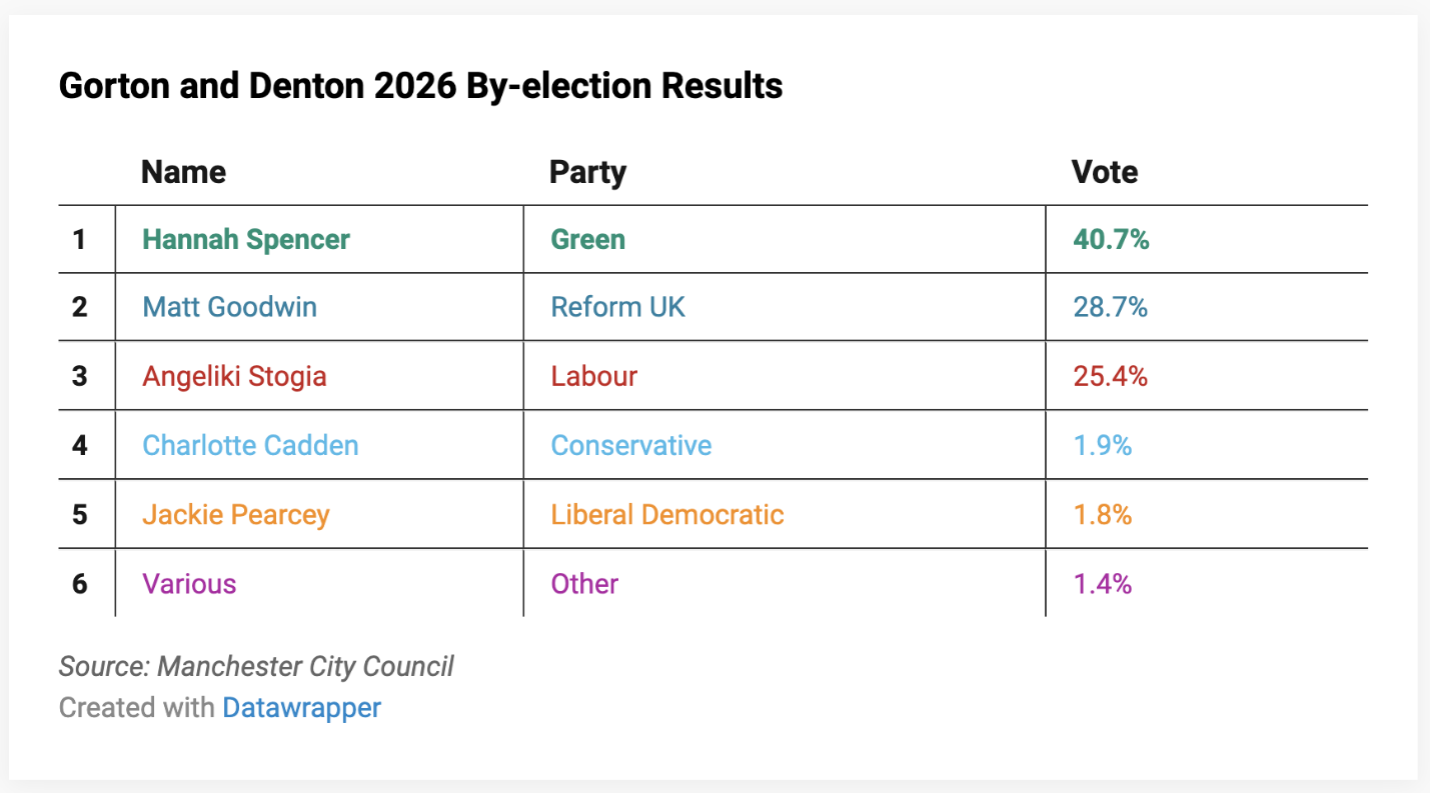
A discussion of the election results can be found here, the first essay of this two-part series. In sum, the Green Party surged in this constituency in comparison to the 2024 election; the Reform Party made significant gains; the Labour vote dropped in half; and the Conservative and Liberal Democratic candidates both performed so poorly that they “lost their deposits.” In addition, this was the first time in English history when neither a Conservative nor Labour party candidate was among the top two finishers in a parliamentary election. This is consistent with the “hollow center” thesis, which is worrying center-left and center-right parties across the global north.
Hannah Spencer: the Green champion
Spencer, the victor, was widely described during the election campaign as a plumber, and some outlets noted that she qualified as a plasterer during the campaign. As such, she was portrayed as a genuine working-class candidate, in contrast to the small number of Labour Party parliamentarians who had ever worked in the trades.
She was not a political newcomer, having served as an elected member of the Trafford Council since 2023. She also ran for mayor of Greater Manchester in 2024 as the Green Party candidate, placing fifth, which was a record vote for the party (across the three elections in the short history of this office).
Her victory did not emerge from nowhere; the Greens have recently gained political ground, winning four seats in the 2024 parliamentary elections (with 6.4 percent of the popular vote) after years of single-seat representation in the Commons. They also made gains in the 2024 local elections.
A week before the election, the Green Party website distributed a statement by Spencer, which included the following:
Voters are fed up with Labour, and rejecting Reform’s division. Matt Goodwin has come up from London to spread rubbish about our communities, and by voting Green we can show him how wrong he is. I’m proud to be a Mancunian, proud that we look out for each other and proud that we’re showing the difference a positive and hopeful message can make.
The leader of the party, Zack Polanski, said the following in the same press release:
This election is about hope versus hate. Greens versus Reform. And this poll shows it. If people want to keep Reform out, then they need to vote Green on the 26th February.
Taken together, both statements indicate that the Greens were pushing the message that Reform was its main competition, not Labour. They also suggest that the party saw tactical voting as key to the outcome. This is when individuals vote not for their top choice but for the candidate best positioned to defeat their last choice. In this case, the party hoped to “unite the left” around Spencer in order to block the populist right.
Andy Burnham: the Labour dog who was not allowed to bark
The candidate who was conspicuous by his absence was Mayor Burnham of Greater Manchester. This relatively popular figure won the 2024 mayoralty contest by over 50 percentage points against the Conservative candidate, and in January 2026, he sought to stand as a Labour candidate in the by-election. This move was controversial, as some felt he was looking for a way into the Commons in order to challenge Keir Starmer for the leadership of the Labour Party.
As an elected mayor, however, he needed the permission of the party’s National Executive Committee to run, which was refused. Whether this was done at the behest of Starmer, or due to Labour worries about the need to conduct a new mayoral election, may never be known with certainty. Some not only believe he would have won but also that Labour’s decision allowed the Greens to become “the primary home for progressive voters.”
Matt Goodwin: Reform Party
Dr. Goodwin is typically described as a former professor turned political activist. He initially became known for his research on the far right and populism in Britain, but some claim he ultimately “went native.” His response is that “My political journey reflects the journey that has been taken by millions in this country. I’ve consistently talked about working class-people in this country being left behind and cut adrift by this country, battered by globalisation and migration.”
The GB News presenter is also known for anti-wokeism, and his controversial statements about migration and citizenship—which were consistent with standard populist-right rhetoric—were noted in the campaign. According to the Financial Times, “His previous comments on race, integration, and Islam have been weaponised by his opponents in a constituency that is nearly 30 percent Muslim.” Goodwin claimed his statements were misrepresented and “sought to make the by-election about local problems” and Labour’s failures.
While he was sometimes portrayed as a London carpetbagger dropped into the constituency by Reform, Goodwin wrote that “when I became the first person in my family to go to university, where did I go? Salford [University, in Manchester]. . . . I worked my way through university. I even delivered pizzas to neighbourhoods in this very seat, driving around the streets of Burnage in a clapped-out Ford Fiesta! I could deliver 3 pizzas in 30 minutes! . . . And when I got my first proper job, which city welcomed me back with open arms? Manchester again.”
Angeliki Stogia: Labour Party
Her campaign was somewhat overshadowed by the non-candidacy of Andy Burnham, who supported her on the campaign trail but was widely seen as the Labour figure with a higher likelihood of winning. Nevertheless, she was not new to politics, having served as a Manchester city councillor and had previously run for both the House of Commons and the European Union Parliament.
She described herself as a “proud Mancunian woman” and argued in a Guardian essay that “We see Thursday’s byelection as a straight fight between us and [Nigel] Farage’s poisonous politics. I think people will vote for each other—and for hope.” She also criticized the Greens (“Promises rather than delivery, that’s the reality of the Greens in power”) and Hannah Spencer (“while pretending she cares about this constituency, is simultaneously contesting local elections in a leafy suburb on the other side of the city”).
Nevertheless, the Labour strategy was to portray the race as a contest between them and Reform, just as the Greens claimed their main opponent was Reform, not Labour. It is remarkable that a party that performed so well in 2024 (both nationally and in this constituency) was struggling for relevance less than two years later.
The Conservatives and Liberal Democrats: missing in action
While both parties contested the elections, neither candidate made much noise nor drew many votes. Charlotte Cadden, a retired police detective, carried the flag for the Tories. She won just under 2 percent of the vote, and the psephologist John Curtice called it the worst ever performance of the Conservative Party in a by-election. On the other hand, this area is not a stronghold for the Tories. Its candidate in 2024 also performed poorly, winning about 6 percent of the vote.
Nevertheless, a vote drop of two-thirds does indicate a Conservative Party at the crossroads. In the face of strong competition from Reform, it must choose whether to chase populist-right voters (and become the “Reform-Lite” party) or carve out an identity on the traditional center-right. The latter is the approach of the new Prosper UK movement, and it was part of the successful strategy of Péter Magyar and the Tisza Party in the recent Hungarian election.
The Lib Dem candidate was Jackie Pearcey, a local campaigner and school governor with a doctoral degree in physics. While the party has a reputation for doing well in by-elections, Greater Manchester is not its natural habitat. Its candidate was not far behind the Tories, receiving about 1.8 percent of the vote. The party did only slightly better in 2024, receiving 3.8 percent, which suggests it never had a realistic chance in this constituency.
In addition, a former leader of the Lib Dems, Vince Cable, urged party supporters to vote Green as a way to defeat Reform. This may have been interpreted by Lib Dem supporters as implicit permission to vote tactically. After the election, a writer for LibDemVoice.org expressed what many in the party might have thought: “Having another young, progressive woman in Parliament is so much better a result than it could have been.”
The post-election spin
The post-election speeches and messaging of Spencer and Goodwin provide clues not only about the campaign itself but also about Green and Reform themes in future contests.
Spencer emphasized “hate vs. hope” and inclusiveness, although the latter did not extend to billionaires. Here are some excerpts from her first post-election press conference:
“I couldn’t be more proud to represent Gordon and Denton—and by that I mean the whole of Gorton and Denton.”
“I don’t want to dwell on it for too long today, but I’ve been appalled at some of the divisive, dog-whistling campaigning from other parties. Everyone here belongs. Everyone deserves to have their needs met. Everyone deserves a voice in our democracy.”
“Today, the people in this constituency have sent a clear message. They’ve rejected hate and embraced the politics of hope.”
“I am so proud that we fought a positive campaign against the Reform Party that dances to the tune of their billionaire donors who don’t want to pay their fair share of tax.”
And in her victory speech, she said the following:
“Life has changed. Instead of working for a nice life, we’re working to line the pockets of billionaires. We are being bled dry . . . we are sick of our hard work making people rich.”
One factor that played little role in these statements was the environment, aside from mentions of “the dirty air,” “beaches you can safely swim at,” and “fly tipping” (illegal dumping). This is consistent with the argument that the Greens have transitioned into a populist-left party and turned away from their roots. If so, this may hurt the party in Tory areas where it has successfully challenged them on environmental themes. While one analysis found more environmental content during the campaign than Spencer’s recent rhetoric might suggest, observers will want to track public perceptions of the party.
Matt Goodwin’s tone was very different. After a defeat that has been described as disappointing but not disastrous, he blamed it on a “coalition of Islamists and woke progressives. . . . I think the Greens are riding a very dangerous wave.” He added that “We are losing our country. A dangerous Muslim sectarianism has emerged. We have only one general election left to save Britain.”
Nigel Farage said it was a “victory for sectarian voting and cheating” and raised “serious questions about the integrity of the democratic process in predominantly Muslim areas.” He was also “accused of Donald Trump–style election denial by the Green party’s new MP for Gorton and Denton, after he claimed her Reform rival 'came first’ among British-born voters in last week’s byelection.”
The cheating claim is a reference to illegal “family voting,” which is “where a family member is seen to be influencing somebody else’s vote, for example by entering the polling booth with them.” However, the Manchester police found no evidence of coercion during the by-election. Farage denounced this as an “establishment whitewash,” although the Reform Party chair stated that it had “probably not” changed the outcome.
If “family voting” had occurred in large numbers, and especially among Muslim voters, Goodwin and Farage might have seen a silver lining. Presumably any such voters were not planning to support Reform until dissuaded by relatives. They would likely have been Labour supporters persuaded to vote Green, and if 1,215 had actually stuck with Labour (out of the 14,980 votes received by Spencer), Goodwin would have been pushed into third place.
About the post-election claims about “sectarian” voting, one might note the long English history of connections between religion and the parties. Most famously, the Church of England has been described as “the Tory party at prayer,” and recent research finds that “affiliating with the Church of England remains a significant predictor of affective attachment to the Conservative Party and of their electoral support.” We might also recall the saying attributed to Harold Wilson that “The Labour Party owes more to Methodism than Marxism,” as well as the long history of non-conformist voting for the Liberal Party.
In a land with an official state religion in which King Charles III is the “Defender of the [Protestant] Faith,” it is a little late to discover that religion and politics may connect, or to imply that religious motivations for voting are somehow illegitimate. Good luck explaining that to Trump voters.
Conclusions
The Gorton and Denton by-election result reflects multiple causes, which we might categorize into long-term dynamics, medium-term concerns, and Election Day factors.
In the first category is the declining support for the two major parties; the shifting relationships between class and partisanship (also known as the “diploma divide”); and the rise of both right and left populism. Such changes have been in the works for decades, but the first-past-the-post electoral system obscured these underlying shifts in the electorate. As a Hemingway character said about his bankruptcy, it happened “gradually, then suddenly.” The party system may now be in its “suddenly” phase, as changes in the electorate are now large enough to disrupt the long-standing dominance of the Tories and Labour.
More recently, Labour’s divides on welfare reform, the continuing problems with the cost of living and economic growth, and possibly the recent Peter Mandelson scandal hurt the party’s candidate at the polls. The Gaza issue did not help Labour among Muslim voters, although broader complexities have emerged among minority groups that traditionally supported the party. And the government chasing Reform on the migration issue may have hurt more than helped in the voting booth. While Labour has worried about the challenge from the populist right, it may be that the populist left is the greater threat.
On Election Day, the Greens benefited from tactical voting, as a large number of undecided voters, many of whom likely voted Labour in 2024, appear to have broken for Spencer. This suggests that a “unite the left” strategy may be emerging at the grass roots in opposition to Reform, regardless of whether the parties create any official or informal electoral pacts. This is consistent with Ben Ansell’s argument that “bloc politics” has emerged in which vote switching largely takes place within clusters of like-minded partisans. Nevertheless, tactical voting could spread across blocs depending on the local context. A Tory supporter faced with a choice between Labour and the Greens may well choose the former rather than “wasting” a vote on the Conservative candidate.
The election results also indicate that traditional polling must be interpreted with caution. When YouGov tried to take into account local tactical voting, this lowered the Reform Party’s support, which led to criticism by Farage. Nevertheless, pollsters may need to use such approaches to understand voter decisions in a closely contested, multiparty environment; the result may be less favorable to Reform than the media drumbeat of “Prime Minister Farage” suggests.
For the future, the key question is whether the populist impulse will continue to grow. One could argue that Reform has stalled, and that Green support may also hit a ceiling if the party is perceived as more interested in left-wing politics than the environment. We will also want to know which populist theme proves more popular: the anti-billionaire appeals of the Greens or the anti-immigration politics of Reform. While both are examples of simplistic populist scapegoating, their appeal may grow if Britain’s problems remain frustratingly intractable.
The imminent May 7 local elections will provide additional information about the state of the parties, but local governments in the UK have limited powers. Such contests are often low turnout affairs that are a “vehicle for protest voting.” We might therefore interpret any populist victories with some caution, even as the media and pundit classes engage in their usual post-election hot takes and sensationalistic coverage. Only parliamentary elections can fundamentally reshape the UK, and the next one is likely three years away.

